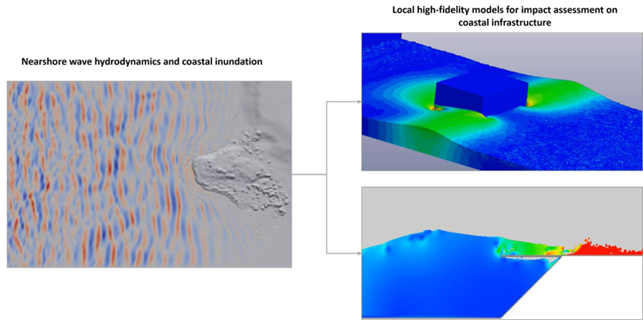
Recent events, such as the October 2023 Baltic Sea storm surge causing about €200 million in coastal infrastructure damage, highlight the risks we study. Our team investigates extreme coastal hazards and wave–structure interaction, focusing on storms, hurricanes and tsunamis, and the resulting nearshore wave propagation and inundation. We analyze impacts on (i) critical coastal infrastructure (ports, bridges, buildings), (ii) cultural heritage, and (iii) natural environments (beaches, cliffs). We develop high-fidelity CFD models using the finite-volume (FVM), finite-element (FEM) and smoothed particle hydrodynamics (SPH) methods, complemented by physical modelling and experiments in the AUWaveTank Facility and field observations. In a recent project, LiDAR is applied to map coastal wave fields and adjacent dune systems to assess how climate change alters coastal morphology. Together, these approaches improve fundamental understanding of coastal hazards, support the design of innovative coastal protection and climate adaptation strategies, and feed into multi-scale risk assessment frameworks that bridge climate science, ocean science and civil engineering to inform disaster management strategies.