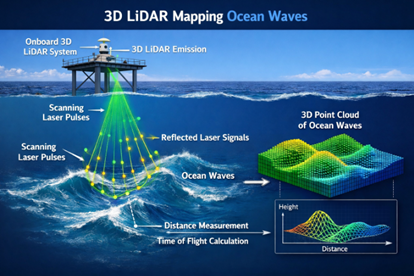
Water waves in the ocean and in laboratory settings have traditionally been measured using one-dimensional techniques. However, point measurements inherently fail to capture spatial variability over areas comparable to the footprint of offshore structures, where wave statistics and crest extremes are governed by spatio-temporal variability rather than single-point behavior. In our research group, we focus on applying the non-intrusive remote sensing technique LiDAR, which enables accurate spatio-temporal measurements of free-surface elevation. Such measurements are essential for understanding wave evolution, wave breaking, and wave–structure interactions. In addition, we conduct experimental investigations of wave-induced loading on offshore structures, making extensive use of our recently acquired wave tank facility, and aim to understand the wind-wave interaction and its effect on structural loading. Moreover, we develop high-fidelity fluid–structure interaction (FSI) modeling using the Arbitrary Lagrangian–Eulerian formulation and hybrid particle–finite-element methods to resolve nonlinear wave kinematics, slamming, green water, and dynamic structural response. For marine renewables, we develop FSI-based design tools for floating offshore wind turbines, modeling semi-submersible floats and integrated systems to quantify motions, internal forces, and stress–strain fields under operational to extreme sea states, benchmarking against industry standards. Parametric studies optimize float geometries, mooring concepts, and wind-farm layouts. Coupling these models with regional ocean and wave models allows us to assess climate-change impacts on offshore wind in harsh basins such as the North Sea, supporting sustainable, risk-informed deployment of marine renewable energy and multi-use platforms.